Legends of Brookner

A measure of the addictiveness of an author is the quantity of legendary material that surrounds her. Dickens does not inspire the Dickensian life, nor Trollope the Trollopian. One doesn't long to be subject to a Bildungsroman, living in a world where everyone has a funny name*; nor to be a provincial clergyman or a British parliamentarian. But one follows yearningly the course set out by Brookner, odd and unique as it may prove. She is uncompromising: this is the life, and it is the only life to live.

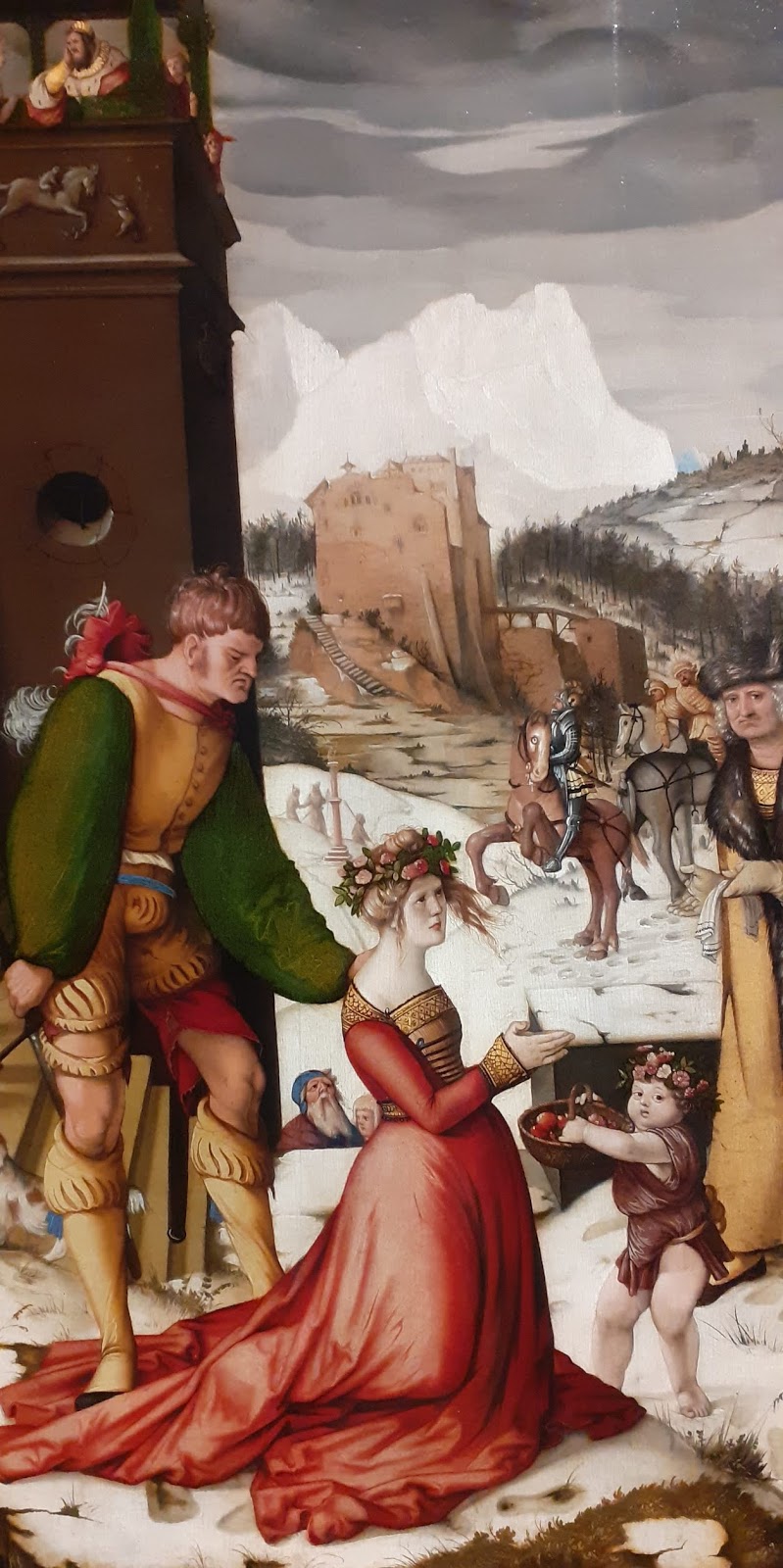
To Germany again, for she perversely visited small towns and cities in France and Germany, the more obscure the better. To Karlsruhe, to the Staatliche Kunsthalle, where I saw a Hans Baldung Grien exhibition...


...along with favourites from the permanent collection: this Temptation of St Anthony by Joos van Craesbeeck...


...and this Jan Sanders van Hemessen, Loose Living:


The St Anthony, one of the most arresting paintings, is hidden away and uncelebrated. You can't even buy a postcard of it.

In Stuttgart I had to race round the picture gallery and the Tiepolo show before it closed early for New Year's Eve. In the evening I saw La Cenerentola at the rather dowdy opera house - but a riotous and joyous performance, with singers invading the stalls, cross-dressing, quotes from the 'Dinner for One' TV sketch Germans love so much, and general Silvester horseplay.


*Enjoined by her emigrant father to read Dickens from an early age, that she might discover the key to Englishness, she was, she said, surprised to find, at school, that not every English person had 'a funny name'.

Comments

Happy New Year to you. I hope you had a terrific time in Germany. It must be wonderful to fit all the wonderful things to see and do during your holiday. The hallucinated imagery of St. Anthony's painting reminds me of Bosch, and later on, Richard Dadd and in some way, a large screaming head in the centre might be seen as a precursor to Francis Bacon's head of "screaming popes".

I've been catching up with your most recent posts and thoroughly enjoying them. It somehow makes me want to go back and read James, Trollope and Dickens all over again. Currently, I am in the American territory with an author who sadly didn't win the most recent Booker Prize. The novel took her several years to complete. The fact that her publisher wrote a beautiful article on loss and their deepest regret in not getting the prize in the TLS made me buy the novel to read it. If you want a similar story told from a male's perspective, I suppose that this novel comes close to a much shorter novel with only 144 pages called "The Mezzanine" by Nicholson Baker (1989).

I sometimes wonder if Anita Brookner was either a night owl or insomniac. A lot of her characters in her novels take sleeping pills. There are a lot of references to night time imagery in her work. "Beneath the visiting moon". One novel she wrote has a title, "Falling Slowly" which is a phrase come from BBC Radio 4 Shipping Forecast which usually broadcasts quite late at night or in the early morning. I bet it must be one of the tracks she would have chosen if she was asked to appear as a guest on Desert Island Discs among all the other French and German composers and perhaps, a little obscure English art song with the lyrics comprise of "Arcady, Arcady is always young" as a dedication to her mother who was a singer.

Many thanks for reading this rambling message.
The Brooknerian said…
Very good to hear from you again. Brookner's characters seem to favour early nights - 'de bonne heure' - but indeed often with the aid of pills. Several keep ominous stashes. As to music, Brookner seems, like James, not to have been too adventurous. There are minor references to Schumann and Brahms but little else.

I was certainly fascinated by the St Anthony painting. I was introduced to it on Radio 4 some time back in a programme called Moving Pictures, well worth seeking out on the BBC app. The artist was apparently a baker by trade, and his other pictures are more conventional. Disconcertingly the 'big head' was a self-portrait, and the face reappears in a more workaday painting, I think in Antwerp.

Happy New Year!

Popular posts from this blog

Top Ten Brookner

The much-loved Backlisted podcast ( here ) returns with a 'lockdown' episode that includes a lot of Anita Brookner talk. Prompted by discussion about  Hotel du Lac , never the most representative Brookner, the chat meanders pleasantly on to the potential for compiling an Anita Brookner 'Top Ten'. At a loose end myself, though this week at the chalkface entertaining the children of keyworkers, I considered the question myself. I'm sure there are similar such lists elsewhere on this blog - I forget, and I don't particularly want to consult them anyhow. Of course, Brookner - like Henry James, like Trollope, indeed like many prolific authors - passed through phases. Brookner's novels, I contend, fall into three, neatly divided by the decades she wrote in: the raw, vital 80s; the settled magisterial 90s; the bleak, experimental 2000s. A Brookner novel from the 80s seems very different from any of her final works - just as 'James I', 'James II' ...

Photo Op #3

The new Penguin paperback edition of Strangers (2009), with its introduction by Tessa Hadley (see here ) and its thick gatefold or French fold cover, is an opulent affair. Oddly, its livery is distinct from other recent reissues, instead mimicking an earlier version of Hotel du Lac . Of interest is the inclusion of an author photograph. It's a shot from a 1986 set by Peter Jordan. It's the session where Brookner sits at her dining table, a book open before her, bookshelves and peace lilies behind. She wears an open-necked cream blouse and a small wristwatch. Other shots from the session show Brookner holding her neck, leaning her chin on her hands, folding her arms, smiling, turning aside. The one chosen for Strangers is suitably equivocal - folded arms, slight turn of the head, left eyebrow slightly more raised than normal, downward-angled lips. It's the first time a photo of Brookner has appeared on a British edition since the hardback of Visitors in 1997, the last und...

'Babbling with Brookner': Interview Discovery

Val Hennessey's interview with Anita Brookner in  You Magazine,  9 August 1987, marks the publication of Brookner's seventh novel  A Friend from England . The piece, 'Babbling with Brookner', anticipates Julian Barnes's warning to a later interviewer: 'You will find yourself babbling'. Hennessey is a fan, Brookner her 'literary heroine'. She once bumped into Brookner outside Waitrose and said embarrassing fannish things. Brookner 'stood shifting uneasily from foot to foot, wide-eyed and fearful, like a trapped hare'. Later they met by chance on a number 14 bus. Both Brookner and Hennessey were shopping for outfits, Brookner for 'something tweedy and dull': she gets off and is seen heading into The Scotch House, a purveyor of quality Scottish clothing. Hennessey phones Brookner to arrange an interview. Brookner expresses alarm and consternation: she finds interviews 'an ordeal'. On arrival Hennessey compliments Brookner on her ...

Brookner Biography Announced

A brief post to let Brooknerians know the moment has arrived: a biography commissioned by Chatto & Windus, to be written by Hermione Lee. Hermione Lee interviewed Brookner on television in the 80s. Brookner joins illustrious company. Lee has lifed, among others, Virginia Woolf and Edith Wharton.

Christopher Hampton's Hotel du Lac

However often I watch it, I'm always surprised. A film of an Anita Brookner novel seems as outlandish as an adaptation of, say, late James. But The Golden Bowl and, more skilfully, The Wings of the Dove have been successfully translated to the screen in recent decades. Their plots, though, underneath the verbiage, are very simple, even sensational. Hotel du Lac , similarly, is one of Brookner's more structured, plotted works. Rights to the novel were bought before its Booker success. Initially Anita Brookner had been approached to write an original screenplay, but she said she wouldn't know how to. Instead she offered the soon-to-be published  Hotel du Lac . (This is revealed in the 2002 commentary that accompanies the DVD of the 1986 TV film. The commentary is a dull, low-powered affair. No Brookner, of course.) Anna Massey plays Edith. I've often found Massey a distractingly distinctive actor. Like Judi Dench she manages somehow, in any role, alwa...

Anecdotally

I last saw [Anita Brookner] in the summer of 2010, when the publisher Carmen Callil brought her to lunch. She was frailer, and needed a stick. I had made potted crab, to which she said she was allergic, to my embarrassment (should I have known?). Instead she took a little cheese, some green salad and a roast tomato; she declined the beetroot. We asked about her life. She said that she went out early every morning to her Sainsbury's Local for 'a croissant, a petit pain and a loaf'. 'Every day, Anita?' 'I eat a lot of bread.' She had been rereading Stefan Zweig and applauded that most Brooknerianly-titled novel  Beware of Pity . She agreed with Carmen that the one advantage of age was that the trials of the heart were behind you. She stated that she had no religious feelings or beliefs at all. She still rented her television (no digibox or Freeview), and still smoked eight or 10 cigarettes a day. 'Do you have your first after breakfast, Anita?' 'O...

A Fraudulent Encounter

I met Anita Brookner only once. I was in a London street with my French friend Marie Delemotte. It was August 1992, and I was nineteen. Marie was much older - ours was a cross-generational friendship - and when I excitedly told her the identity of the rather elderly-looking woman tottering towards us on the pavement, my friend, unimpressed, said, with what I probably would have called Gallic insouciance, 'Oh, go to her! Why not?' But my heart was thumping. Here was my heroine, my favourite author - here in a London street, at two o'clock on a summer's afternoon - here, in the flesh, or the somewhat exiguous flesh, for the woman approaching us was very thin and seemed frail. She walked with a stick. But Brookner would only have been in her sixties in 1992, and was to live another twenty years and more. She wore a white blouse, a white skirt and a red blazer with large shoulders. Her hair, bright auburn, looked newly coiffed. The street was Elm Park Gardens, Brookner...

Photo Op #2

Further to recent posts on Brookner photographs and harder-to-find images in particular, I offer this from The Times , June, 1994: John Voos's portrait accompanies a review of A Private View . The piece, by Philip Howard, is often quoted: 'Anita Brookner is our Henry James'. By way of a title, a line from Browning - 'When the long dark evenings come' - completes an excellent evaluation of one of Brookner's finest novels. The photo is an oddity in the oeuvre: Brookner in the act of speaking. Was it posed? Was it taken at an event? The blurred background suggests the familiar setting of Brookner's London flat. The hard undeceived wistfulness of her gaze, the precision of her discourse, the discontented romanticism of her outlook are all captured by a master photographer.

Brookner Interview Discoveries #1: Finding the Art of Fiction

Regular visitors to this blog will know of my devotion to Anita Brookner's interviews. Five are available on the web - the Paris Review interview, the 1990s Independent interview , and three from the 2000s (the Observer , the Independent again, and the last interview in 2009 in the Telegraph ). In printed form there are the Olga Kenyon and the John Haffenden interviews, both from the 1980s. The Haffenden exchange remains to my mind the best Anita Brookner interview. You will conceive of my delight at discovering several fresh interviews on the Guardian / Observer archive website. I propose to cover these over the coming days. We start with a piece in the Guardian on 27 May 1981, 'Finding the art of fiction', published to coincide with the publication of Brookner's first novel A Start in Life . As well as giving in remarkably finished form her later familiar responses to questions about her motivations for writing ('Socially she has always had the sensation of...

Stendhal Again

We had  the recent post * about the after-dinner cigar, and one from a short while back  on the connections between or among Brookner, Sebald and Stendhal, and yesterday I enormously enjoyed reading a text** by Jack Robinson (Charles Boyle) from CB Editions , An Overcoat: Scenes from the Afterlife of H. B. ,*** which I discovered by chance in the  Guardian Review . The text is powered by its footnotes - and what pleasure there is in finding on pp. 4-5 a quotation from Brookner's 1980 TLS review of a Stendhal biography, collected in Soundings : 'Anita Brookner', says Robinson, '...approves [Beyle's] furious attempts "to measure up to the rules of the game, even when [my [i.e. Robinson's] italics] there was no game being played ".'**** Though Brookner isn't directly referenced again, the italicised line is mentioned twice more, on p. 81 and p. 128. The other echoes are numerous. Beyle, while watching a mosquito bite on his ankle, reme...