The Next Big Thing (2002) [published in the US as Making Things Better] is a late masterpiece, a sober terrifying novel. Here's a reading and study guide, focusing on general themes, particular details and critical reaction.
***
The Next Big Thing presents a hero shaken by lust after a lifetime of humbly 'making things better'. Seventysomething Julius Herz, the third male protagonist in recent novels, is a self-effacing childhood émigré from Germany. Late in life, he finds release from the family ties that bound him to a solitary stoicism. Passive, obedient, too keen to please, Julius shares more than his Mitteleuropa background with some of his female forerunners. As I list his traits, Brookner breaks in: 'He's me, really. You were longing to say that, weren't you? And I thought I was making him up. That's what happens. That's where Freud is right.'
'He's me, really.' The Next Big Thing - Anita Brookner's Madame Bovary 'C'est moi!' novel? It's a tempting notion. The novel is probably my favourite Brookner, though when I first read it, in 2002, I thought it a reheating of previous works, A Private View in particular. I see it differently now. I see it in the context of what would prove to be a late flowering, a late phase. We now see The Ambassadors, The Wings of the Dove and The Golden Bowl as a magnificent whole, but they probably read differently as they came out: inaccessible, odd, the product of a talent on the skids.
***
Observer: Where do you think your ideas come from?
Brookner: I wish I knew. I'd tap into them straight away. I think it's mostly dreams and memories, isn't it, as with all novelists? And a certain amount of observation, obviously.
'Herz had a dream': it's a forthright beginning - not wholly elegant, but it does the job. Interesting that two later works - Leaving Home and 'At the Hairdresser's' - also begin with dreams. Would she have considered doing that in earlier novels? Would she have cited dreams so highly? Those early books, one feels, were written in the white heat of experience, or something close to it. The later works - the works of the 2000s - are no less arresting, but they are different, and should be recognised as such: strange, difficult at times, but representing for Brookner a kind of Indian summer. Or winter, perhaps.
 |
| UK first edn. paperback: note the low perspective, as if Herz were a child, or Sophie Clay's inferior. |
***
Liliane Louvel's scholarly essay 'Reading with Images: Anita Brookner's The Next Big Thing as Memento Mori' is recommended. It takes an 'intermedial' view of the novel, comparing it with a range of memento mori artworks. The essay sheds light on key relationships in the book - with Herz's brother and with his neighbour Sophie Clay. It is heartening to find such a sympathetic and respectful reading of a Brookner novel, and intriguing that it comes from outside the anglophone literary world.
***
...their new cramped quarters.
The Next Big Thing, ch. 3

***
In chapter 4 of The Next Big Thing, Herz considers, and then rejects, a visit to the National Gallery to look at the Claudes and Turners - 'aware that art was indifferent to whatever requirements he might bring to the matter'. Art had proved 'fallacious' for his doomed brother Freddy, 'as if it were preferable to be the equivalent of a playground bully, a ruffian, rather than the suffering aesthete he had been in his former life'.
This isn't, however, for Brookner a late-life repudiation of her former calling. Even as a teacher she would (as we see below) tell her students, brilliantly and subversively, 'Art doesn't love you and cannot console you':
Olivier Berggruen, Artforum, May 2016
***
'Sounds hilarious,' says Herz's ex, Josie, in response, confirming her function in the novel: the obverse not just of Herz's long-lost love Fanny Bauer, but also of many things Brooknerian. We know what Brookner's about here. The Next Big Thing is one of the most self-referential of her novels, referencing not only her many previous books but also what she told us about her own life. Think of that 1981 essay in Soundings, on Rosa Bonheur, which begins with a vignette of Brookner herself 'indolent and homesick' in a French provincial city, turning as ever to the museum, and 'from long experience' following the arrow which says Ecole française XIXe. siècle. The paintings found there match 'one's nostalgia for simple rules, simple illustrations, simple nourishment. But of course such things were never simple; they were at all times complex and sad'.
***
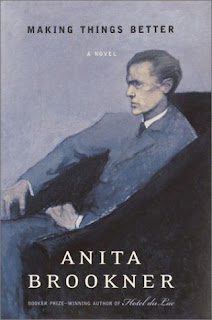
The Next Big Thing is Making Things Better in the States. Why? The publishing practice of sometimes altering titles to suit a particular audience has been the topic of an earlier post (see here), and it still intrigues me. Here both titles fit. The phrase 'making things better' is noticeable for the frequency of its repetition; it appears in the text more often than 'the next big thing'. 'Making Things Better' perhaps feels more upbeat, if also laced with irony. 'The Next Big Thing' is possibly the truer title, inasmuch as it sums up if not the main theme of the novel then certainly the plot's major thrust. But it's a brutal phrase - daringly inelegant. Brookner's choice of titles never struck me as a strong point, and might even have put off potential readers. She never quite found a unifying 'pattern' for her titles - unlike, say, Ivy Compton-Burnett, another prolific writer. At best we can call 'The Next Big Thing' a brave title - and the novel is nothing if not brave.
With almost Nabokovian ardour Brookner conjures Herz's past, the ride down the Lichtenthalerallee in Baden-Baden, coffee in the Kurhaus gardens. A remarkably similar scene occurs in Falling Slowly, suggesting an autobiographical origin. Baden-Baden is indeed different now: a resort for the super-rich, no longer for the merely bourgeois. The bourgeois past, Herz finds, is to be found only in his reading: in Thomas Mann's short stories or in Buddenbrooks. Elsewhere in The Next Big Thing the modern world intrudes. Mobile phones, email. Globalisation. People trafficking? The seamstresses who work in a neighbouring flat at the start of the novel appear to be irregular migrants. Their employer, Mrs Beddington, admits as much to Herz. He notices the girls' absence during the summer: perhaps they've gone home ('to homes he had difficulty in imagining' (ch. 6)) or on holiday, though later the repellent Mrs Beddington tells him, laughing, 'Girls like that don't go on holiday'. In fact she's shut up shop: 'they're on their own' (ch. 9).
The past in The Next Big Thing has a 'refulgence' (ch. 5), but Brookner is a realist too, especially in this, one of her later novels, into which a cheerless and subtly horrifying new world impinges more and more.
The Next Big Thing links most obviously with Strangers and A Private View, but in its subtle and reticent treatment of the Holocaust its truest confrère is probably Latecomers. In particular one thinks of the restaurant scene between Hartmann and Fibich in that earlier work. It is so understated that one can almost overlook it as the novel's climax:
Brookner in her late work - when, as it were, a decent time had passed since her retirement from the Courtauld - returned in something like earnest to her earlier calling*. There were the books of criticism, Soundings and Romanticism and Its Discontents. And there were novels like The Next Big Thing, with its numerous art references. Here Herz is looking through his collection of old art postcards. But I confess I can't identify the image of a dressmaker and her impassive client.
* though Julian Barnes believes art criticism and novel writing occupied quite separate parts of her mind. He speaks of how she would light up and be transformed when asked over dinner her views on, say, the painter Boucher.
The Next Big Thing (2002), like many Brookners, seems to be set in the present day of the book's publication. (The 2016 Penguin photographic covers, however, generally suggest vaguely antique - 1950s, 1960s - settings.) There's a mention of email (or 'e-mail', as Brookner puts it) and mobile phones.
But Fanny's letter from Bonn (admittedly received after a delay, but only a short one) in chapter 13 complains of property prices having rocketed since so many government agencies set up shop in the city. Yet by 2002 German reunification was well established, and such bodies would surely have departed. Nowadays Bonn has a sleepy, sedate, slightly posthumous air.
But dating problems of this kind are not unusual in the novels of Anita Brookner. One learns to glide over them. What is important is the atmosphere of the novel, the texture - here the whole mittel-European world Fanny's letter so richly creates.
Or do I romanticise? Would an equivalent English city be so evocative? What would an equivalent city be? Leeds?
I once visited Bonn, seeking out the suburb of Poppelsdorf where Fanny lives for a time. I remember the morning as strange, magical - and I think there's something of that feeling in the photographs I took.


This isn't, however, for Brookner a late-life repudiation of her former calling. Even as a teacher she would (as we see below) tell her students, brilliantly and subversively, 'Art doesn't love you and cannot console you':
By nature a shy and reserved figure, Brookner had a great flair for self-analysis. She also understood her students and their motivations with keen psychological insight – she encouraged the viewer to articulate his own feelings, as well as a vision based on his own character. The work of a particular artist, say, David, had to be analysed within the larger framework of historical circumstances; yet subjectivity could not be avoided. In the case of David, she saw the revolutionary hope of creating a world of higher morality and virtue dashed as the artist anticipated the Romantic ideal by relinquishing intellectual control. Most crucially, Brookner believed that art had to be emotionally alive, and she advocated Baudelaire's 'impeccable naïveté,' which she termed the 'ability to see the world always afresh, either in its tragedy or in its hope.'
Her advice was invaluable. Nearly every sentence she uttered is engraved in my memory. My fellow student Cornelia Grassi remembers the last thing Brookner said to her before our written exams: 'Art doesn't love you and cannot console you.' As Baudelaire recognised, it provides temporary solace, at best.
'I went to cities. At first I went to all the glamorous ones: Venice, Rome. But I did in fact feel rather lonely there. Then I realized that I didn't have to go to those places, that I was happier in small towns of no particular interest. So I picked the ones in which I could please myself, without witnesses. France, mostly. I was more or less contented when I could just amble round a church, and then sit down and drink coffee and read the local paper, half hear other people's conversations.'
The Next Big Thing, ch. 4
'...I'm looking at the end. The next big thing.' (Ch. 5)
...the fallacious enterprise of making things better. (Ch. 15)
The Next Big Thing is Making Things Better in the States. Why? The publishing practice of sometimes altering titles to suit a particular audience has been the topic of an earlier post (see here), and it still intrigues me. Here both titles fit. The phrase 'making things better' is noticeable for the frequency of its repetition; it appears in the text more often than 'the next big thing'. 'Making Things Better' perhaps feels more upbeat, if also laced with irony. 'The Next Big Thing' is possibly the truer title, inasmuch as it sums up if not the main theme of the novel then certainly the plot's major thrust. But it's a brutal phrase - daringly inelegant. Brookner's choice of titles never struck me as a strong point, and might even have put off potential readers. She never quite found a unifying 'pattern' for her titles - unlike, say, Ivy Compton-Burnett, another prolific writer. At best we can call 'The Next Big Thing' a brave title - and the novel is nothing if not brave.

***
That world no longer existed, or if it did would have undergone a change...
The Next Big Thing, ch. 6
The past in The Next Big Thing has a 'refulgence' (ch. 5), but Brookner is a realist too, especially in this, one of her later novels, into which a cheerless and subtly horrifying new world impinges more and more.
***
After examining the photograph he had the fleeting feeling that he was in the wrong country.
The Next Big Thing, ch. 6
He dropped his head, made a helpless gesture with his hand and knocked over a glass of water.
'Fibich!' said Hartmann warningly, summoning a waiter.
'I should have gone back,' whispered Fibich. 'I should not have left. I should have got off the train.' (Ch. 14)
***
...an arresting image from the National Portrait Gallery of a dressmaker pinning the skirt of an impassive client who resembled Fanny Bauer (black hair, dark eyes, prominent crimson mouth, and bad-tempered expression)...
Anita Brookner, The Next Big Thing, ch. 9
* though Julian Barnes believes art criticism and novel writing occupied quite separate parts of her mind. He speaks of how she would light up and be transformed when asked over dinner her views on, say, the painter Boucher.
***
He saw his madness for what it was, the final upheaval of an unlived life...
A Private View, ch. 10
Such signs, such frustrated gestures, were surely evidence of a cruel joke, perpetrated on him by his own unlived life.The Next Big Thing, ch. 11
***
He knew that he was in danger of losing his head, may already have lost it, but submitted to the experience, even welcomed it.
The arrival of Ted Bishop, accompanied by his infant grandson, roused him from what may have been a brief trance.
There may even have been jealousy behind the iron closeness that united Fanny and her mother; neither was allowed to break their primitive agreement.
Anita Brookner, The Next Big Thing, chapters 10, 11, 17
Now reread those sentences. Is there a problem? I'm not sure. Plainly they're in the past tense. And 'may' is certainly the present tense modal of which 'might' is the past tense version. But should Brookner really therefore have written 'might' instead of 'may'? Many writers would, without misgivings, have written those sentences.
The problem, I think, is with the additional meanings or functions of 'might', i.e. its use not just as the past tense of 'may' but also as a means of expressing simple future intentions or possibilities in a language devoid of a future tense (I might go to the shops later), plus its common deployment in sentences expressing the hypothetical future or past (I might go to the shops later, if it doesn't rain / I might have gone to the shops if circumstances had been different). Use of 'may have' rather than 'might have' in sentences such as Brookner's above avoids these associations.
But here's Adam Mars-Jones on the subject, in a review that's not untypical of the way Brookner was received in some quarters during parts of her career:
The only sign of an awareness of contemporary language in The Next Big Thing is an unconscious one: for all her fastidiousness she succumbs to the confusion about 'may' and 'might'. He knew that he may have lost his head. He saw that she may have known. If her prose is to be lifeless, let it at least be correct.
***
 |
| Flowers in the botanical gardens, Bonn |
The Next Big Thing (2002), like many Brookners, seems to be set in the present day of the book's publication. (The 2016 Penguin photographic covers, however, generally suggest vaguely antique - 1950s, 1960s - settings.) There's a mention of email (or 'e-mail', as Brookner puts it) and mobile phones.
But Fanny's letter from Bonn (admittedly received after a delay, but only a short one) in chapter 13 complains of property prices having rocketed since so many government agencies set up shop in the city. Yet by 2002 German reunification was well established, and such bodies would surely have departed. Nowadays Bonn has a sleepy, sedate, slightly posthumous air.
But dating problems of this kind are not unusual in the novels of Anita Brookner. One learns to glide over them. What is important is the atmosphere of the novel, the texture - here the whole mittel-European world Fanny's letter so richly creates.
Or do I romanticise? Would an equivalent English city be so evocative? What would an equivalent city be? Leeds?
I once visited Bonn, seeking out the suburb of Poppelsdorf where Fanny lives for a time. I remember the morning as strange, magical - and I think there's something of that feeling in the photographs I took.


***
Over the years The Next Big Thing has come to be, for me, not just my favourite Brookner but the novel I consider her masterpiece.
- It's an analysis of the effects of the Holocaust on different people: Herz, who has lived his whole life 'as if it were under threat', and Fanny Bauer, who has chosen forgetfulness, who has 'dropped out of history'.
- It's a study, rarely matched in modern fiction, or indeed in any fiction, of age and then the only end of age.
- It's a misalliance tragedy, a study of disastrous love. One reads the Sophie Clay episode with one's heart in one's mouth. And yet towards the end of the novel Brookner humanises Sophie, makes her vulnerable, turns the tables.
- It's a novel about the inner life - 'his own interior drama took precedence' - with pages of deep analysis of which Henry James would have approved. But it's also a novel in which art fails: Herz, as if suffering a loss of faith, favours, at the last, nature over art. Yet The Next Big Thing contains some of Brookner's best art criticism.
- And it's a novel 'for the fans'. It has echoes of, among others, Latecomers, A Private View, Visitors and Falling Slowly - even, in Fanny's residence at the Beau Rivage, of Hotel du Lac.
Comments