 |
| UK first edition cover image |
Undue Influence occupies an interesting position in the Brookner oeuvre. It's the last of the 1990s novels, but it recalls her first three works of the early Eighties (A Start in Life, Providence, Look at Me). On publication (1999) it seemed like either an end or a new beginning. And the following year, 2000, was the first time Anita Brookner broke the annual writing pattern she'd established through the previous two decades.
From 1990 I'd read Brookner as she was published. When I first read Undue Influence, and when there was no new novel a year later, it really did seem possible she might have given up fiction, as she had more than once threatened to do.
***
It was not the first time I had been guilty of a misapprehension.
Chapter 1 of Undue Influence (1999) is a Brookner curiosity. It functions as a prelude, connected only thematically with the plot that will get under way in the next chapter. It sets me thinking of the Prelude to Middlemarch, which I first read in my teens. Why, I wondered, was George Eliot telling me about St Theresa?
Chapter 1 of Undue Influence, which ends with the ominous line above, concerns the narrator's failure to understand events in an upstairs flat. I am reminded of Jane Manning in Brookner's A Family Romance, who misconstrues the identity of a pair of French Canadians in a neighbouring apartment. I think also of Barbara Pym and her sister and their elaborate fantasies or 'sagas'. Inspired by the 1930s novelist Rachel Ferguson (The Brontës Went to Woolworths), the Pym sisters would all but stalk their unsuspecting neighbours and other strangers they observed out and about in the locale. The progress of several such sagas is covered cheerfully and in some depth by Pym's biographer Hazel Holt in A Lot to Ask: a Life of Barbara Pym.
 |
| Vigilant: Pym in 1979 in Finstock, Oxfordshire |
I could sell you anything in the shop, since I am so familiar with the stock. But I prefer the living flesh and its ambiguity. I am in my element there, a hunger artist whose hunger is rarely satisfied.
Brookner's protagonists are hunger artists in that there's a degree of complacency in their austere self-presentation. But there's also, as here, a sense of insatiable and perhaps unsuitable appetites - appetites that must be controlled, circumscribed and to an extent suppressed. The true Brooknerian wouldn't want it any other way.
My mother had been an art student when girls at the Slade wore long belted smocks and had waved and curled hair. I know this - about the hair, that is - because there is a portrait of her by Sir Gerald Kelly in our dining-room. He seemed to have caught her essence, although she was very young at the time: she is seated in three-quarter profile, with her hands in her lap, the hair caught with particular precision. She has that absent-minded dreaming look that women had in those days, and which must have been de rigueur for girls of a certain class.

More concretely we get references to Blakeney in Norfolk. We're always alert when Brookner's characters venture from London into the English provinces, where danger lurks. Blakeney features also in Brookner's 1992 novel Fraud, and there's another intriguing detail found in both books. In Fraud Dr Halliday (similar to Martin Gibson in Undue Influence) must endure trips in his odious father-in-law's boat. In Undue Influence Martin Gibson's stepfather takes him on a boat trip, which he finds an emetic experience (and we know from A Friend from England that water is rarely to be trusted).
I was resigned to the laws of this rough world. I would take my chance, and with it the penalties, for there are always penalties. I had spent that morbid Sunday wondering if simple happiness were available to all and had come to the conclusion that it was not. One had to make a determined bid for it, and I did not quite know how this was to be done. [...] I had taken the only options I thought I had, and had considered myself secure against disappointment. The disagreeable element in all this was that I knew that nothing would come of such manoeuvres, invigorating though they were. I returned every time to the status quo ante [...] If my way of looking at the world was hazardous, it was, by this date, largely unalterable.
There's a growing opacity in the writing. Claire, that 'merry adventurer' (ch. 8), brings back from her mysterious holidays postcards and photos for her mother: rood screens, tympanums, choirstalls, misericords, clerestories, elevations: Brookner takes a perverse pleasure in listing such arcane details. 'As if these had had exclusive claims on my attention,' jauntily adds Claire. But Brookner soon pulls away the rug:
I faltered when I found that [my mother] had compiled several albums of the postcards, which she kept in her bedroom. She was so innocent herself that I am sure she managed to think me innocent as well. (Ch. 3)In Undue Influence we're getting towards late dark comfortless Brookner, the bleakness of The Bay of Angels, the harsh clarity of The Rules of Engagement, the empty, barely mediated despair of Strangers.
The power of tenses in Brookner. This is worth some study. I've previously considered the apparently muddled time scheme of Look at Me (see here), and something similar is at work in Undue Influence. Take the following, also from chapter 8:
She found it safer to treat me as the joker I had become, but she is concerned for me, as if she knew that I was in danger, that I deliberately, from time to time, courted danger.Precisely when is the narrator writing? Long after the event, or at the time? That present tense 'is' unsettles us, and this is perhaps deliberate. These matters aren't cosily over and done with. They're still current, still potent, still perilous. Nothing in Brookner is ever quite safe: even a reread is rarely a comforting experience.
St John Collier wrote innocent uplifting pieces for old-time women's magazines. Later, when a brasher world arrived, he took to writing notes for a projected memoir about his London walks.
But Claire discovers the notebooks to be disappointingly empty of interest. His walks became, over time, limited and half-hearted. There was a suggestion of a secret liaison with a woman called Agnes. 'I cannot go on,' he wrote on the last page of the notebook. 'There were no words left,' concludes Claire.
St John Collier's predicament mirrors or anticipates the growing dislocation and disaffection suffered by Claire herself. It also recalls a poem of Philip Larkin's, 'Forget What Did' from the High Windows (1974) collection.
In 'Forget What Did', a rare unrhymed poem, Larkin describes the process of 'Stopping the diary': a 'stun to memory', a 'blank starting'. Such writing had done no good, had only 'cicatrized'. And the empty pages? Larkin sees himself filling them with the kinds of things that might have interested Brookner's St John Collier:
Celestial recurrences,(Philip Larkin himself was a diarist. But when he knew he was dying he instructed his secretary (and sometime lover) Betty Mackereth to shred them. Reportedly she sneaked a peek: they were, she said, 'too terrible'.)
The day the flowers come,
And when the birds go.

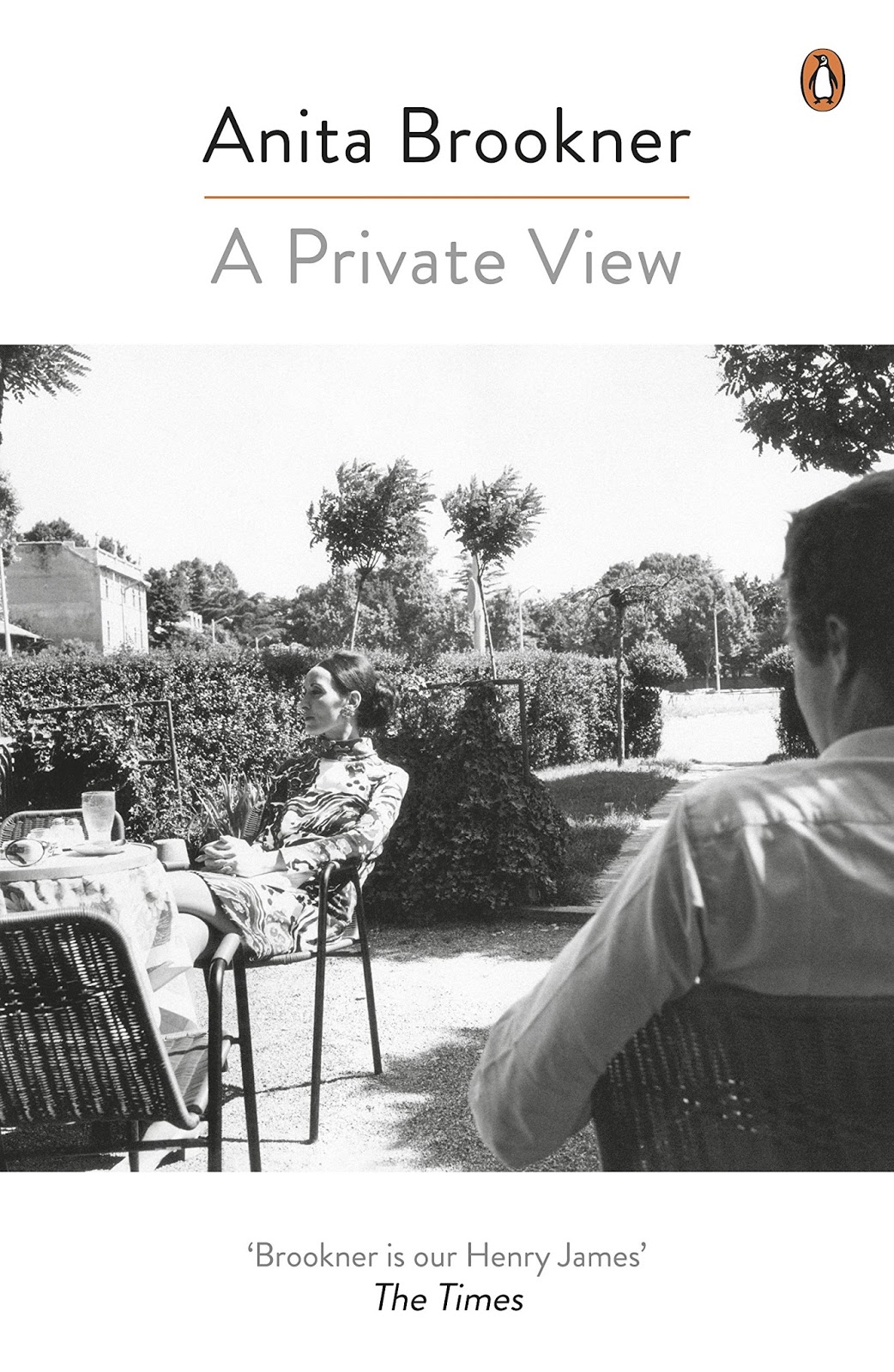 |
| 2016 reprint cover: George Bland's tourism |
***
I was disheartened by the fact that he was entirely at home in this place, and furthermore in places where a certain opacity of behaviour was the norm - restaurants, luxury hotels, sojourns in other people's houses. There would be little room for spontaneity, for direct exchange, even for a kind of honesty.
I wonder: was the behaviour of the guests at the Hotel du Lac similarly opaque? But that was in 1984, and this is 1999. Brookner, in her critique of the luxury lifestyle, is acknowledging a new world, quite divorced from the sort of traditional establishment she celebrated in her earlier novel. It's the world of big business, of corporate wealth. 'Money would have schooled these people,' she says a little later; '...money, rather than anything as vulgar as class.' As vulgar as class? The old Hotel du Lac was riddled with class, but now it would be quite different.
Brookner moves on. With Undue Influence we're leaving the old century, but Brookner isn't fazed. She mightn't have kept up to date with all aspects of the modern world, but like Virginia Woolf she did know that things change, even human nature.
It was only August, but the summer was virtually finished. Thick cloud was rarely pierced by anything resembling normal sunshine, and what heat there was was excessively humid, spoiled. Only that morning I had found a large moth spreadeagled on my bedroom wall, with no tremor at my approach. This attitude seemed to mirror my own inertia, although inertia now seemed to me something of a luxury I could no longer afford.
Moths that fly by day are not properly to be called moths; they do not excite that pleasant sense of dark autumn nights and ivy-blossom which the commonest yellow-underwing asleep in the shadow of the curtain never fails to rouse in us. They are hybrid creatures, neither gay like butterflies nor sombre like their own species...Virginia Woolf, Anita Brookner: moths that flew by day.

'Of course. Goodbye, Muriel. I hope it all...' All what? Goes well? How could it? They were finished, that was manifest. And they had done so well! Such spotless lives, shipwrecked at the last, when they had not expected it! Even Muriel had now given in, or rather given up. Applause erupted from the television. 'Don't see me out, Muriel. You must be rather tired.'
'Yes,' she said. 'I am tired. Thank you, Claire. Goodbye.'
'Goodbye,' I said. But she had already turned away.
 |
| 2016 UK cover |
After Undue Influence (1999) there came an unprecedented gap in the publication pattern Anita Brookner had established over nearly twenty years. There was something in 2000, but it was a book of art criticism, Romanticism and Its Discontents. In 2001 the fiction resumed, but Brookner told Robert McCrum she hadn't intended to write the novel of that year. Undue Influence might well therefore have been Brookner's last novel.
We read Undue Influence now, or I do, as pointing forward to the darker novels of the 2000s. For sure it is a bleak tale, all the more so for the airiness of its opening chapters. The sly author lulls you into the impression that this is some kind of easy-going Brookner-lite, before steadily turning the screw. Towards the end you realise you're keeping company with a narrator who may well be mentally ill, and a writer who's intent on ruthlessly clearing the decks of extraneous plot so that she can concentrate on heaping the maximum humiliation on her hapless protagonist.
How Claire Pitt suffers! Brookner deprives her of every support. I always find appalling the moment when she considers spending an entire holiday in Hyde Park. The novel's ending, as grim but more concise than the conclusion to Look at Me, never fails to shock, even though on rereading the reader has probably been able to spot the careful way Brookner has seeded the novel with clues.
One of the novel's concluding lines:
It was the greatest failure of my life and no future success could ever obliterate it.- brings to mind again the question of the time scheme. The suggestion here is of a long retrospect, which is at odds with the closer focus at work throughout the novel. But if this suggests a lack of novelistic polish, it also, I think, successfully evokes the unfinished rawness of the heroine's experience.
Comments