
Where I Went in the Holidays

To Hamburg, Lübeck and Travemünde

I came to the conclusion some time ago, after years of puzzlement, that I don't really like any weather. My favourite sort of day is a dry day, a little chilly, in spring or autumn. I was once in Dallas, and the temperature was more than 40⁰C. My day at the Southfork Ranch was a trial.

We had a miserable English winter this year, then a heatwave from June. I suffered. In Germany it was worse - even in the north, supposedly subject to sea breezes. In Hamburg I hunkered close to the Kunsthalle, discovered Cranachs, appreciated an exhibition about disasters.

Lübeck and Travemünde: no Brookner connection, other than Thomas Mann, Buddenbrooks in particular, which plays its role in The Next Big Thing. I've been to the Buddenbrookhaus before. It is, like many such buildings in Germany, largely a reconstruction. Then to Travemünde, where the Buddenbrooks took their holidays, now a sizable port serving destinations as far away as Helsinki. I stayed a little along the coast at Timmendorfer Strand, a long beach, almost exclusively German. One could hire a Strandkorb, of which there were thousands, like a larger wicker porter's chair. This is apparently a great tradition.


Below: Planten un Blomen, Hamburg; Eugène Isabey, Wreck of the Emily; Cranach the Elder, Christ Blessing the Children; detail of last; Timmendorfer Strand; parched England


To Brussels and Ghent

A much milder, pleasanter break in Belgium at the end of the holidays. Ghent is a discovery. Previously I've been only to the Museum voor Schone Kunsten, where I like to visit the Géricault portrait it is my pleasure or burden to use as an Internet avatar. (Click on the Géricault label below for more posts relating to the artist.) The museum retains its charm (it's virtually unvisited), despite a rather savage recent rehang.

Ghent itself is a delightful bourgeois city, with much in common with Bruges: a medieval centre, canals, churches. Then to Brussels - edgy as always, edgier still this time, or so it seemed to me. But I had my usual mooch around the art museums, revisiting the Bruegel that inspired Auden's poem, the Davids Brookner revered - all those.


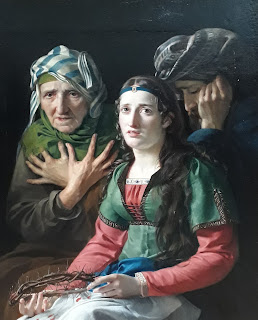
Below: [Ghent] an old friend in new company; Casorati, Girl on a Red Carpet, 1912; Navez, St Veronica, 1816; Paelinck, Anthia Leading Companions to the Temple of Ephesus, c. 1820; detail; De Vigne, Fair in Ghent in the Middle Ages, c. 1862


Below: Ghent by night and day


Below: [Brussels] Khnopff, Listening to Schumann; Jordaens's Bacchus, a lesson for us all


Comments

Rosemary Kaye said…
That is exactly the weather I love - still, cool, preferably autumnal (but far away from Christmas not to have to think/worry about that). I remember a day I was driving though Aberdeenshire. It was autumn, cloudy, still. There were men (farmers, not rich bankers) shooting in one of the fields, but for some reason they had all stopped and lowered their guns, and were just standing, waiting. I loathe blood sports but the atmosphere at that moment so perfectly matched the kind of weather that I like that I have never forgotten it - must be 20+ years ago now.

I very much enjoyed seeing all these pictures. I have never been to Belgium. I especially liked “listening to Schumann’, so much story in one painting.

Thank goodness the hot weather has gone. I was in southern France this summer and the heat spoiled it for me really. MIght just stay in Scotland next summer.
The Brooknerian said…
Great to hear from you, and your evocation of an autumn scene is magical.

I certainly found refreshment in art this year. A painting can create a kind of microclimate on even the most oppressive of days.

Popular posts from this blog

Top Ten Brookner

The much-loved Backlisted podcast ( here ) returns with a 'lockdown' episode that includes a lot of Anita Brookner talk. Prompted by discussion about  Hotel du Lac , never the most representative Brookner, the chat meanders pleasantly on to the potential for compiling an Anita Brookner 'Top Ten'. At a loose end myself, though this week at the chalkface entertaining the children of keyworkers, I considered the question myself. I'm sure there are similar such lists elsewhere on this blog - I forget, and I don't particularly want to consult them anyhow. Of course, Brookner - like Henry James, like Trollope, indeed like many prolific authors - passed through phases. Brookner's novels, I contend, fall into three, neatly divided by the decades she wrote in: the raw, vital 80s; the settled magisterial 90s; the bleak, experimental 2000s. A Brookner novel from the 80s seems very different from any of her final works - just as 'James I', 'James II' ...

Brookner Biography Announced

A brief post to let Brooknerians know the moment has arrived: a biography commissioned by Chatto & Windus, to be written by Hermione Lee. Hermione Lee interviewed Brookner on television in the 80s. Brookner joins illustrious company. Lee has lifed, among others, Virginia Woolf and Edith Wharton.

Cousin Henry by Anthony Trollope

It's funny what can put you off a book. Harold Macmillan, it is said, liked to go to bed with a good Trollope, and indeed was often of an afternoon to be found lolling around Downing Street with an old novel. (David Cameron emulated Macmillan - but he called it chillaxing, and Trollope probably wasn't involved.) I once went to a play in London about the Profumo affair, and the Macmillan character waxed patricianly lyrical about Trollope, saying he was currently flicking through Cousin Henry and finding it awfully jolly. I'm a bit of a Trollope fan, or I was once. In fact I've read most of his novels, but some time back. The ones I haven't managed are the early ones ( Castle Richmond and the like) and one or two from the later period that simply haven't appealed. Cousin Henry is one of these. It may be I just find its World's Classics cover slightly repellent. Cousin Henry is one of Trollope's shorter novels. This is actually a point in its di...

Christopher Hampton's Hotel du Lac

However often I watch it, I'm always surprised. A film of an Anita Brookner novel seems as outlandish as an adaptation of, say, late James. But The Golden Bowl and, more skilfully, The Wings of the Dove have been successfully translated to the screen in recent decades. Their plots, though, underneath the verbiage, are very simple, even sensational. Hotel du Lac , similarly, is one of Brookner's more structured, plotted works. Rights to the novel were bought before its Booker success. Initially Anita Brookner had been approached to write an original screenplay, but she said she wouldn't know how to. Instead she offered the soon-to-be published  Hotel du Lac . (This is revealed in the 2002 commentary that accompanies the DVD of the 1986 TV film. The commentary is a dull, low-powered affair. No Brookner, of course.) Anna Massey plays Edith. I've often found Massey a distractingly distinctive actor. Like Judi Dench she manages somehow, in any role, alwa...

'Babbling with Brookner': Interview Discovery

Val Hennessey's interview with Anita Brookner in  You Magazine,  9 August 1987, marks the publication of Brookner's seventh novel  A Friend from England . The piece, 'Babbling with Brookner', anticipates Julian Barnes's warning to a later interviewer: 'You will find yourself babbling'. Hennessey is a fan, Brookner her 'literary heroine'. She once bumped into Brookner outside Waitrose and said embarrassing fannish things. Brookner 'stood shifting uneasily from foot to foot, wide-eyed and fearful, like a trapped hare'. Later they met by chance on a number 14 bus. Both Brookner and Hennessey were shopping for outfits, Brookner for 'something tweedy and dull': she gets off and is seen heading into The Scotch House, a purveyor of quality Scottish clothing. Hennessey phones Brookner to arrange an interview. Brookner expresses alarm and consternation: she finds interviews 'an ordeal'. On arrival Hennessey compliments Brookner on her ...

'...and the forest drooped glimmeringly'

1983's Look at Me finishes with a night walk through London. The walk, which extends over a whole chapter, as if in real time, is harrowing: it's one of the most abject episodes in Brookner. A nocturnal traipse of a different kind occurs towards the end of George Meredith's 1859 novel The Ordeal of Richard Feverel . The hero, as emotionally turbulent as Brookner's protagonist, though for different reasons, moves through a forest in Germany, experiencing everything from dusk to dawn, with a tempest in between. The chapter is satirised in Forster's Howards End (1910). Leonard Bast, visiting the Schlegel sisters, expresses his admiration for Meredith's novel and describes his own emulation of Richard Feverel's night walk. The Schlegels are less enamoured. They know the novel, but find it laughable. They mock, for example, the glimmeringly drooping forest. Such different reactions to a nineteenth-century masterpiece place the characters socially. The sisters, ...

Photo Op #3

The new Penguin paperback edition of Strangers (2009), with its introduction by Tessa Hadley (see here ) and its thick gatefold or French fold cover, is an opulent affair. Oddly, its livery is distinct from other recent reissues, instead mimicking an earlier version of Hotel du Lac . Of interest is the inclusion of an author photograph. It's a shot from a 1986 set by Peter Jordan. It's the session where Brookner sits at her dining table, a book open before her, bookshelves and peace lilies behind. She wears an open-necked cream blouse and a small wristwatch. Other shots from the session show Brookner holding her neck, leaning her chin on her hands, folding her arms, smiling, turning aside. The one chosen for Strangers is suitably equivocal - folded arms, slight turn of the head, left eyebrow slightly more raised than normal, downward-angled lips. It's the first time a photo of Brookner has appeared on a British edition since the hardback of Visitors in 1997, the last und...

Verfall einer Familie: Buddenbrooks by Thomas Mann

'I found your address in a letter from your mother to mine; it was tucked between pages 123 and 124 [*] of Buddenbrooks [**]   which Mother was reading before she died. I have been unable to read the book since that awful day, but I recently took it down when I asked Doris, my maid, to dust the shelves.' Anita Brookner, The Next Big Thing , ch. 13 (Letter from Fanny Bauer to Julius Herz) Who does not enjoy a family saga? Virginia Woolf, never a populist, had much success with The Years , and Buddenbrooks (1901)   remains Thomas Mann's best-loved novel. It covers the years from high Biedermeier 1835 to the very different 1870s in the lives of the Buddenbrook family, a bourgeois*** north-German clan. I've visited Lübeck and the Thomas Mann museum (the ' Buddenbrookhaus ') several times, but in my pre-blogging days, when I took no photographs. But I remember a sedate city, autumn leaves underfoot, and a vaguely marine atmosphere, as of cold seas not too ...

Anecdotally

I last saw [Anita Brookner] in the summer of 2010, when the publisher Carmen Callil brought her to lunch. She was frailer, and needed a stick. I had made potted crab, to which she said she was allergic, to my embarrassment (should I have known?). Instead she took a little cheese, some green salad and a roast tomato; she declined the beetroot. We asked about her life. She said that she went out early every morning to her Sainsbury's Local for 'a croissant, a petit pain and a loaf'. 'Every day, Anita?' 'I eat a lot of bread.' She had been rereading Stefan Zweig and applauded that most Brooknerianly-titled novel  Beware of Pity . She agreed with Carmen that the one advantage of age was that the trials of the heart were behind you. She stated that she had no religious feelings or beliefs at all. She still rented her television (no digibox or Freeview), and still smoked eight or 10 cigarettes a day. 'Do you have your first after breakfast, Anita?' 'O...

Vastations

The skill with which John Banville deploys Jamesian vocabulary and syntax in his recent James-inspired novel Mrs Osmond  (2017) is constantly stimulating and often brings a smile to the grateful reader's lips. It is the principle pleasure of the book. I'm interested by Banville's use of the word 'vastation', meaning spiritual emptying. Has he been reading Brookner? Brookner uses the word in her novel Visitors (1997) .  A character lies sunk in an armchair, as though subject to a 'Jamesian vastation'. In a review in 2005 of Hilary Mantel's Beyond Black , Banville refers to Mantel experiencing 'by her own account' a Jamesian vastation at the age of seven. I cannot date Mantel's account. But Henry James doesn't use the word (though in Notes of a Son and Brother we read of the author being 'vastated of my natural vigour'). ('Vastation' in fact derives from the work of Emanuel Swedenborg, the Swedish mystic to whose do...