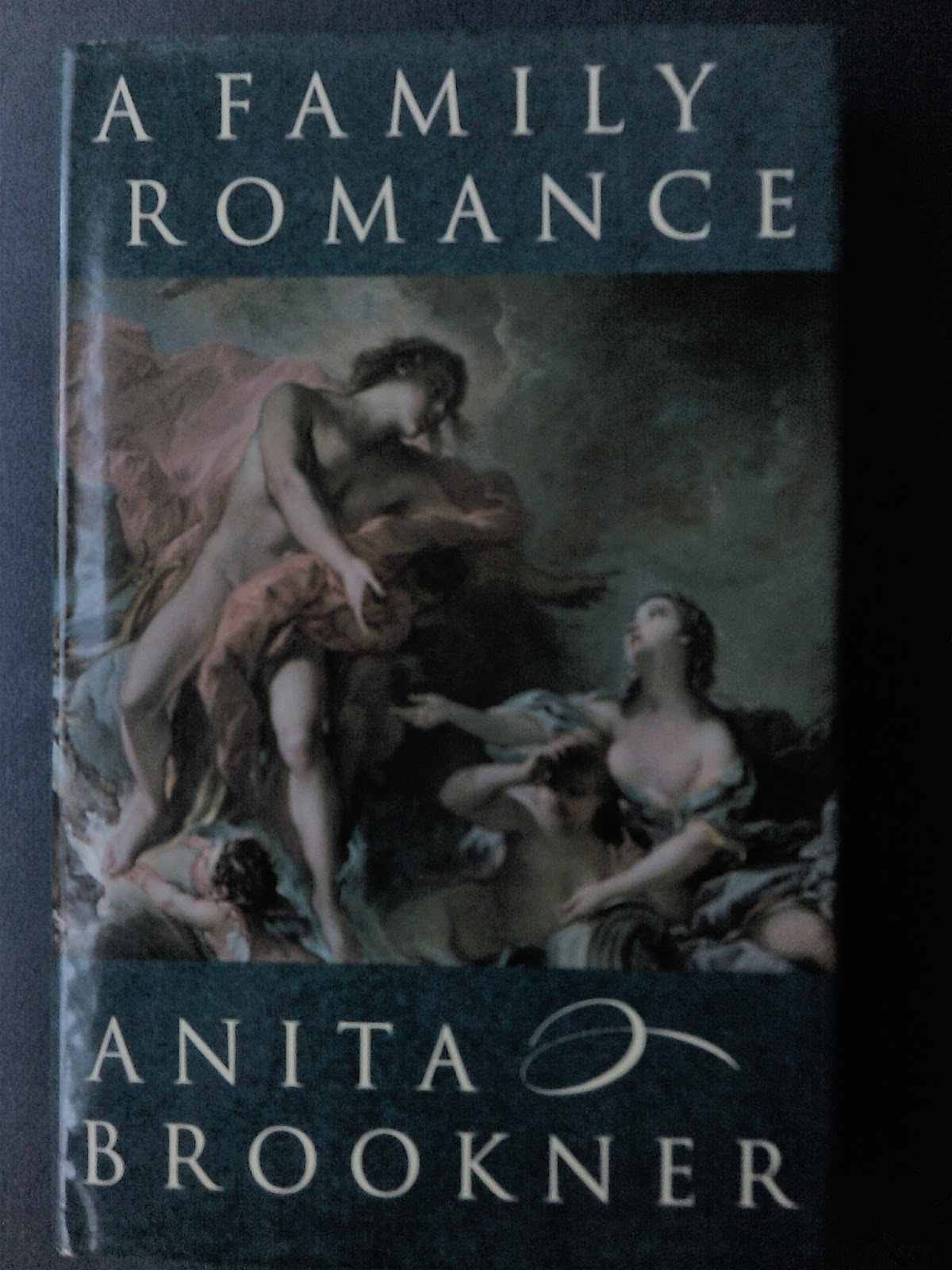
Saturday, 15 July 2017

Dolly and Mme Moitessier

Out of its draped neckline rose a throat that was full at the base and slightly suffused with colour ... Her hair and eyes were dark, her skin a beautiful clear olive and flushed over the prominent cheekbones, but her most characteristic feature was her mouth, which was long and thin, the lips as smooth as grape skins, the lipstick worn away into an outline by her eager tongue ... She had a squat European figure, with shortish legs and a full bosom, the whole thing reined in and made impregnable by some kind of hidden structure.
A Family Romance, ch. 1

There's something very painterly about these early-to-mid 90s Brookners. The chapters are long, about double the length of chapters in earlier and later Brookner novels. This adds to the dense, static atmosphere. Descriptions are full and considered. Reading the above description of Dolly, I am reminded of Ingres's Mme Moitessier in the National Gallery (see an earlier post for more on this painting). I know that this famous painting, its sitter in her impossible dress, is referred to directly in one of Brookner's novels; it may even be in this one.

Friday, 14 July 2017

David and Jane

David Copperfield: We open with an aunt, a 'discontented fairy', and with scenes before David's birth. This is a novel, so the events are imagined by the writer. It is also a first-person narrative, yet these particular events weren't experienced by the narrator; they're therefore as it were doubly imagined, giving the opening of the novel a slightly unreal or magical quality.

Dickens knows this, and makes some effort to explain himself. In the second chapter David is young, but his jewel-bright recollection continues.
...I think the memory of most of us can go farther back into such times than many of us suppose.
...if it should appear from anything I may set down ... that I was a child of close observation, or that as a man I have a strong memory of my childhood, I undoubtedly lay claim to both these characteristics.

A Family Romance: Here too we start with an aunt: 'the aunt rather than ... my aunt, for anything more intimate would have implied appropriation, or attachment'. Magical stories are invoked: 'Dolly's absence I took for granted, for in the manner of fairy tales I assumed that after the apotheosis it was natural for people to vanish'. And we are treated to detailed recounts of events and conversations, even though the narrator Jane was little more than four or five at the time (and in later chapters she dramatises scenes that took place before her birth).

She tells us, perhaps echoing David Copperfield:
It is not true that children do not understand adult feelings. They understand them all too well, but they are powerless to deal with them.
And towards the end of the first chapter is at pains to justify her apparently excellent recall:
These facts were not revealed to me until much later. Many of them I had to supply myself. It seemed to me important to reconstruct the story, even to the point of doing a certain amount of research.

Thursday, 13 July 2017

Summer Books


I'm sure I'm not the only person who spends an inordinate amount of time wondering what to read each summer. For me it must be a long novel, preferably a nineteenth-century novel. Such novels give me lots of comfort on my travels. Art cannot console you, said Anita Brookner. But I'm not sure I agree with her there.

Last summer, before my blogging days, before The Brooknerian was even a twinkle in my eye, I read or rather reread The Portrait of a Lady. That's one of the perils of getting older: the need to reread. I know I should try to find new things to read. But I know what I like, and, as I say, I'm looking for comfort.

2015 seems to have been a low point. I read, for the first time, Thackeray's The Adventures of Philip. The first and only time. In 2014 it was Clarissa, 2013 The Princess Casamassima, and 2012 He Knew He Was Right. I could go on.

This year I toyed with the idea of returning to the first Dickens I properly read, Bleak House. (I say properly read because anyone who's been through the British school system will at some point have read Dickens as part of their studies.) But at last I had a minor brainwave and decided on a joint reread of David Copperfield and Brookner's A Family Romance. Jane Manning, as you may know, reads David Copperfield as A Family Romance progresses, and it informs her sentimental education.

So the decision is made. I look forward to starting both soon, with due attention to an annual ritual.


Tuesday, 11 July 2017

Brooknerian Taste

If Brookner in her novels tells us how to live, in her art criticism she teaches us to see and distinguish and value. I enjoyed my visit to the Wallace Collection, but I suspect I may be among the viewers she identifies here:
Greuze's pictures have an immediate appeal - to the sentimental and untutored, of whom, fortunately, there are still many. (Greuze, Conclusion)
Her reaction to the uneven oeuvre of Jean-Baptiste Greuze, perhaps rather more than to that of Jacques-Louis David, subject of her other major study, gives insight into her taste. She dislikes much of Greuze's work, but singles out a handful of works for our appreciation and instruction:
The painter who could respond so openly to the civilized charm of the Marquise de Bezons, who could remember the exact stance of a bashful country girl, who could paint Wille and Sophie Arnould and the luminous infant Bertin* is one who deserves a permanent place not only in histories of art but in the affections of those who try, with a seriousness equal to Greuze's own, to understand the evolution of his century. (Ibid.)
*The Bertin painting featured on the book's dustjacket.

Marquise de Bezons, Baltimore

Study for L’Accordée de Village
Chalon-sur-Saône, Musée Denon

Portrait of Wille
Paris, Musée Jacquemart-André Collection

[Formerly thought to be] Portrait of Sophie Arnould
Wallace Collection

Portrait of E.-F. Bertin, Louvre

Monday, 10 July 2017

The Europeans

There can be few plot devices more stimulating to the conservative imagination than the arrival of brilliant strangers.  'It is sometimes very moral to change,' says Felix, one of the Europeans in Henry James's novel of that title. But the irruption into established lives of disruptive influences, and the resulting clash of cultures, are often an opportunity merely for the status quo to be upheld, even renewed - at any rate only very subtly adjusted.

One thinks, of course, in this context, of Brookner's Visitors. It has something of the charming summery atmosphere of The Europeans. But really there are numerous examples of Brooknerians who are faced with alternative ways of living. But how much do any of them change, or indeed want to change? And how moral are the changes they so ardently but hopelessly contemplate?

Mrs May, at the end of Visitors, looks back on her recent past: its upheavals have been, after all, merely 'diverting', just as she thought they would be. And now the visitors are gone, and the world can settle to what it was.

Saturday, 8 July 2017

The Brooknerthon

New to Anita Brookner? Let me suggest a route into and through what a critic (unfavourably but memorably) once called the long dark corridor of her fiction.
  1. Start with a late-period novel. Brookner's fiction divides roughly but usefully into three phases: the 1980s, the 1990s and the 2000s. The early work is inconsistent but often brilliant; the middle period is more settled, more even. In Brookner's last works we see a return to the unpredictability she started with, now allied to a greater assuredness of form and style. Start with The Next Big Thing (Making Things Better) (2002). Also try The Bay of Angels (2001) and The Rules of Engagement (2003). Scarier than the scariest horror story.
  2. Next try the essential early Brookner: Look at Me (1983). A remarkable and quite extreme laying out of the Brookner manifesto. The final chapters contain some of the bleakest and most unsettling passages in the whole of English literature. Temper this with the novel of the following year, Hotel du Lac - not quite a comic reworking of Look at Me, but certainly much lighter.
  3. Stay with the early phase for the moment and experience the full flowering of a quality often missed in Brookner's novels: compassion. Try Family and Friends (1985) or Latecomers (1988). 'Searchingly gentle,' said Ruth Rendell of the latter.
  4. You'll probably need a break by now. Why not take a sidestep into the world of Brookner's criticism? She wrote for the TLS, the LRB, the Burlington, and prolifically for the Spectator. The Spectator's archive website is far from perfect, but it's free, and with a little effort you'll find Brookner gems aplenty.
  5. The real solid substantial part of the Brookner oeuvre came in the 1990s. Magisterial is the word. Try A Family Romance (Dolly) (1993), A Private View (1994) or Visitors (1997). Unshowy, unfashionable, and made for the future.
  6. Brookner's art criticism is of enormous value and always instructive. Easiest to get hold of are Soundings (1997) and Romanticism and Its Discontents (2000).
  7. Finish your journey (with still much to enjoy) with either Brookner's bleak last novel Strangers (2009) or her funny sprightly first, A Start in Life (The Debut) (1981). You choose. You'll know what you like by then.
The long dark corridor of her fiction

Thursday, 6 July 2017

'Never Touch Capital': Mrs Palfrey at the Claremont by Elizabeth Taylor

In Mrs Palfrey at the Claremont (Virago, 1971) Elizabeth Taylor evokes a 60s/70s England - postwar, post-Empire, pre-Thatcher. It's a time of reticence, discretion, austerity, decline. Mrs Palfrey has her rules, her code of behaviour. 'Be independent; never give way to melancholy; never touch capital' (ch. 1). It's an England I remember, yearningly, from my childhood. I find it too in Barbara Pym's 70s masterpiece Quartet in Autumn, though both novels were contemporary in their time.

Nostalgia is a slippery concept, and it's different for different people. For Mrs Palfrey the 'honeycomb housing and the isolation' of modern bed-sitters represent a world that is hostile to her interests. She recalls instead the era of her youth: cooks attending ranges, 'rattling dampers, hooking off hot-plates, skimming stock-pots, while listening to housemaids' gossip brought from above stairs' (ch. 6).

Mrs Palfrey at the Claremont is a novel about old age - 'the disaster of being old', as Taylor puts it in chapter 7. Mrs Palfrey, a widow, has decided to live the rest of her life in a hotel. She arrives, tries to fit in among the other residents. It's a 'reduced and desiccated' version of school (ch. 3). She is immediately scrutinised and judged. Days are difficult to fill, other than with small-minded spiteful perpetually class-conscious conversation (Elizabeth Taylor was a fan, and friend (if that were possible), of Ivy Compton-Burnett, and the influence shows). Mealtimes are of enormous importance:
None wished to appear greedy, or obsessed by food: but food made the breaks in the day, and menus offered a little choosing, and satisfactions and disappointments, as once life had. (Ch. 2)
The comparisons between Mrs Palfrey at the Claremont and the novels of Anita Brookner are obvious. One thinks not only of Hotel du Lac but of Brookner's exemplary novels of ageing: Strangers, The Next Big Thing, Visitors. Taylor's style* is simpler and her novel more social, less introspective, but Mrs Palfrey at the Claremont is often as frightening, as unsparing, as those later Brookners.

I remember John Bayley's review of Brookner's A Private View, another story of the later part of life, and comparable with Mrs Palfrey for another reason. We could, Bayley says, go on contemplating George Bland's circumstances indefinitely - they're as satisfying as poetry - but the show or the plot must go on. In Brookner's novel a young woman insinuates herself into Bland's life, and he falls disastrously in love. Mrs Palfrey similarly encounters a young man, Ludo, and a relationship blossoms - a relationship nowhere near as unwise as Bland's with Katy Gibb, but ambiguous nonetheless.

Mrs Palfrey's experiences are closer to those of Mrs May in Brookner's Visitors. Ludo gives Mrs Palfrey a 'new stake in youth' (ch. 5); whereas for Ludo, an aspiring writer, Mrs Palfrey is potential material. It is a confrontation between youth and age, but the novel's instincts are largely (but not wholly) in the direction of comedy rather than anything darker.

The novel's characters are memorably but sketchily drawn - at least when viewed in comparison with (say) Brookner's intense emotional voluptuaries. But Taylor is dealing with people who don't quite know themselves. Mr Osmond, for example - is he gay? Or Mrs Burton - how and why did she start drinking? Or even Mrs Palfrey - has she ever before entertained unsuitable feelings?

For there is a falling in love. It isn't as violent an experience as George Bland's but it isn't as sublimated as Mrs May's. 'She felt suddenly tired, from love', and later, also in chapter 9:
'What a strange friendship we have,' she murmured, and looked away with a clumsy movement.
The novel is full of such moments - so understated, so aching, so authentic.

(I have actually read Mrs Palfrey at the Claremont before, perhaps about twenty-five years ago. I remembered it for its sharp comic elements. What I got this time was a greater sense of fear, fear in spite of the comedy - fear of old age, of incapacity. It takes a special kind of writer to scare us in that way.)

(I haven't seen the film. It seems to have
a disappointingly modern setting.)
*Taylor's style is of that variety that's difficult to pin down, at least at the level of the sentence. Here's Hilary Spurling, writing about Taylor's style in her biography of Ivy Compton-Burnett: 'clear, pure, almost transparent on the surface, full of ambiguities of humour and feeling below' (Secrets of a Woman's Heart: The later life of Ivy Compton-Burnett 1920-1969, Hodder and Stoughton, 1984, ch. 8).

Wednesday, 5 July 2017

A Capital Place for the Study of Human Nature: 'The Pension Beaurepas' by Henry James

I had ... been told that a boarding-house is a capital place for the study of human nature. I had a fancy for a literary career, and a friend of mine had said to me, 'If you mean to write you ought to go and live in a boarding-house; there is no other such place to pick up material.' I had read something of this kind in a letter addressed by Stendhal to his sister: ‘I have a passionate desire to know human nature, and have a great mind to live in a boarding-house, where people cannot conceal their real characters.’ I was an admirer of La Chartreuse de Parme, and it appeared to me that one could not do better than follow in the footsteps of its author. I remembered, too, the magnificent boarding-house in Balzac’s Père Goriot – the ‘pension bourgeoise des deux sexes et autres’, kept by Madame Vauquer, née De Conflans. Magnificent, I mean, as a piece of portraiture; the establishment, as an establishment, was certainly sordid enough, and I hoped for better things from the Pension Beaurepas.
Henry James, 'The Pension Beaurepas' (1879; 1881 text), ch. 1

'The Pension Beaurepas' is a sort of B-side or companion piece to James's more famous tale of this period on the so-called International Theme, Daisy Miller.

The narrator, a young unnamed American student, is living in a pension in Geneva. His fellow inmates include a randy old gent named Monsieur Pigeonneau; an American family, the Rucks; and another, more sophisticated American pair, the impoverished, heavily Europeanised Mrs Church and her marriageable daughter Aurora.

The pension is run by the shrewd Mme Beaurepas who 'flattered herself that she knew at a glance where to pigeon-hole a new-comer' (ch. 1).

Aurora and her mother are objects of fascination for the narrator and for the narrative. His relationship with them, and with Aurora in particular, is hard to define. '[S]he looked at me askance, with a certain coquetry,' he says in chapter 4. 'But I was an innocent youth and I only looked back at her, wondering.' He's one of James's ambiguities. Why doesn't he want her?

Speaking for ourselves, as readers, we want much more of the intriguing Churches. 'We like the old, trodden paths; we like the old, old world,' says Mrs Church, and James would have us value those things too (ch. 5). He doesn't want us to side with the vulgar Rucks (marvellous name), who are treated comically. But we seem to end up spending rather too much time with the Rucks.

Were the tale longer and fuller, it might gesture towards the tragic. Aurora's situation is the unenviable predicament of many a nineteenth-century heroine. She constantly risks the improper, whereas '[T]here is nothing that a man can do that is wrong, is there? En morale, you know, I mean.' (Ch. 7)

But the narrator never takes her seriously: 'my young lady was excited, and had a charming little passion in her eye' (ch. 7). A 'little' passion, note. How is Aurora to proceed? The narrator assures her in chapter 9:
'It is not the first time that I have been alone with a young lady. I am not at all terrified.'
To which she replies:
'Ah, but I? [...] I have never been alone' - then, quickly, she interrupted herself. 'Good, there's another false note.'
A false note? The bleeding truth, more like it - and the line alone offers a good enough reason for studying this otherwise only mildly interesting tale.

Aurora, near the end, slips from the narrative with nothing resolved. But not before she's intimated to the narrator that her circumstances are so intolerable that she even considers throwing herself on the mercy of the American consul: 'I would beg him to give me money - to help me.'

But the narrator merely smiles, though he feels 'singularly excited'. Again - why? Why?

Aurora, of course, is seen solely through the male gaze. Reading this so close on the heels of Bowen's The Hotel, I am reminded of Sydney Warren in that novel, standing 'as inanimate and objective as a young girl in a story told by a man, incapable of a thought or a feeling that was not attributed to her'. I also turn to the critic Lyndall Gordon. For Lyndall Gordon Aurora is one of James's 'alternative, evolving, thwarted women':
There is something unexplained [in Daisy Miller and 'The Pension Beaurepas'] which has nothing to do with contradictions in the girls... What is unexplained is the conduct of Winterbourne [in Daisy Miller] and the student [in 'The Pension']: their blend of sensitive involvement and withholding. This is seemingly explained by their reasonableness in the face of unreasonable and headstrong girls. We see these girls through the controlling eyes of men who appear to themselves, and to us, pained to hear innocents reviled. So concerned do they seem that we almost forget that they are not only observers or narrators of girls' destruction, but might be seen to have been implicated in that destruction, had we access to the victims' point of view.
Lyndall Gordon, A Private Life of Henry James, ch. 6

Tuesday, 4 July 2017

Mapping out a deep-down life: The Hotel by Elizabeth Bowen

The carnations, among which, walking slowly, she now was burying her face, were scentless, but gave one an acute pleasure by the chilly contact of their petals. She had an armful of two colours - sulphur with a ragged edge of pink and ashy mauve with crimson at the centre, crimson-veined.
Elizabeth Bowen, The Hotel (1927), ch. 9

Could anyone else have written those lines?

I first read Elizabeth Bowen in my youth. I worked in a library and was attracted by several old hardback editions of Bowen's novels. They had woodcut illustrations and magnificent titles. The House in ParisThe Death of the Heart!

It's even possible I read Elizabeth Bowen before I read Anita Brookner. Truth to tell, I think I found both authors hard to 'get into' at first. I loved, at seventeen or eighteen, Hotel du Lac, but found other Brookners difficult. But I persisted. Likewise I kept trying with Elizabeth Bowen, even when my progress through her novels slowed to a glacial pace. I felt a sense of duty. It was as if, in spite of myself, I recognised true worth.

Later, after a long break, I focused on Bowen's postwar fiction. I have a preference generally for the late or later works of authors. It's the same with Brookner. So I read The Heat of the Day (1949), A World of Love (1955), The Little Girls (1963) and Eva Trout (1968), and liked them all. I was probably ready at last.

What does one look for in Bowen? One looks, I guess, for the evocation of liminal psychological states; one looks for the personification of the inanimate; and one looks for style.

Would I find these in early Bowen?

In a spirit of curiosity about other hotel-set novels, I turned to The Hotel, Bowen's first novel, immediately after my reread of Brookner's Hotel du Lac.

Bowen's novel tells of the lives of a group of English people living in a hotel (usually 'a', not 'an' as in Brookner) on the Italian Riviera. They're a Forsterian bunch: young women, matriarchs, spinsters, eccentrics, a clergyman. Bowen captures the period with precision: the cropped hair and daring short skirts of the girls, the Victorian attitudes of the oldsters, and everywhere the shadow of the Great War.

An early scene involving an excursion into the hills surrounding the Hotel (always capitalised), and an illicit kiss, was almost certainly inspired by Forster's A Room with a View.

Bowen's focus is diffuse, but if there is a central character it's a young woman named Sydney Warren. Bowen is plainly fascinated by her. Sydney is depicted with a 'wild, Beatrice Cenci expression' (ch. 10); she's said to be 'queer' (ch. 5), whatever that means; and her sexuality is the topic of oblique discussion:
Tessa continued: 'Sydney is very affectionate.'
'She is very much ... absorbed, isn't she, by Mrs Kerr?'
'I have known other cases,' said someone else, looking about vaguely for her scissors, 'of these very violent friendships. One doesn't feel those others were quite healthy.' (Ch. 8)
But Bowen's project is nothing so pedestrian. 'What is the good of a new world if nobody can be got to come and live in it?' says a character in chapter 16. That new world is the world after the war, and Sydney surely belongs in it.
Beatrice Cenci
As for the Hotel, it functions as the hotel did in Brookner's novel. It creates unusual matches. 'In an ordinary way, in London, we should run miles, I dare say, rather than meet,' someone tells Sydney in chapter 15. There's a similar sense of time in the Hotel being somehow richer than elsewhere, and a little out of joint. 'Hotel time', we learn, is 'reckoned differently' (ch. 16).

In its last quarter the novel seems to threaten to become a conventional romance. Sydney suddenly accepts an offer of marriage, but Bowen (like Brookner with Edith's) has Sydney's best interests at heart. Her handling of Sydney's gradual awareness of her situation is exceptional:
She stood between Tessa and Mrs Kerr as inanimate and objective as a young girl in a story told by a man, incapable of a thought or a feeling that was not attributed to her, with no personality of her own outside their three projections of her: Milton’s fiancée, Tessa’s young cousin, Mrs Kerr’s protégée, lately her friend. (Ch. 23)
The Hotel is, overall, a remarkably confident debut: brilliantly controlled, radical, subversive. 'I'm afraid', says a character at one point, '...that one's friends, however various and delightful they may be at other times, are least interesting ... at these moments when they approximate most closely to the normal. What people call life's larger experiences ... are so very narrowing.' (Ch. 19)

***

So to my Bowen tests, which the author passes not with flying colours but certainly with plenty of promise. First, liminal psychological states. Take this, from the opening:
Miss Fitzgerald hurried out of the Hotel into the road. Here she stood still, looking purposelessly up and down in the blinding sunlight and picking at the fingers of her gloves. She was frightened by an interior quietness and by the thought that she had for once in her life stopped thinking and might never begin again.
Or this, from chapter 9:
[Sydney] was mapping out for herself a deep-down life in which emotions ceased their clashing together and friends appeared only as painted along the edge of one's quietness.
Or from chapter 20:
Her personality had a curious way of negativing her surroundings, so that unless one made instant resort to one's senses the background faded for one and one conjured up in one's half-consciousness another that expressed her better, that was half an exhalation from herself.
(No, I'm not at all sure what that means.)

Next, personification:
...the air was allowed to come in pleasantly through the open windows under green-striped awnings and feel its way, cool-fingered, from flushing face to face. (Ch. 3)
And lastly, style. Notice here the Bowenesque coinage 'excludedness' and the weird deployment of italics:
She seemed, from the desolation, dusk and excludedness of the lounge, to return at least into something. (Ch. 7)

Sunday, 2 July 2017

'Why the country is so mean': Robinson by Jack Robinson

...this country, by all measures one of the wealthiest in the world, appears to be so dilapidated, destitute, shorn of hope ... The UK is rich; there is wealth inequality, but that alone doesn't explain why the country is so mean.
Robinson, ch. 3

Just over a year ago the UK voted to leave the EU. There are still some who celebrate this decision.

Daniel Defoe's Robinson Crusoe was published in 1719. Many people still think of it as a charming and harmless tale, even a book for children.

Jack Robinson's Robinson, with quiet subtlety and in detail, links and dismantles both these conceptions. 'Jack Robinson' is Charles Boyle of CB Editions and this is the companion volume to An Overcoat, earlier appreciated on this blog. It is as good and as brilliant as An Overcoat. Each is the A-side of the other.

Novel? Memoir? Literary criticism? Diatribe? Robinson politely requires that we abandon such labels. But what is the book about? It's certainly about Defoe's novel, a text that tells us much that we need to know about Empire, the schools system, British society, masculinity. But Robinson is also about the present, and the referendum result in June 2016. The narrator explores these things in the company of a figure called Robinson. And who is this Robinson? But one must resist the temptation to categorise. That is perhaps the message of the book: that categorisation is what got us into this mess in the first place.

The breadth of literary reference is impressive. No Brookner, but there wouldn't be. (There are no references to Defoe in Brookner's critical work,* nor Robinsons in her novels - at least as far as I know.) But Brooknerians will be pleased by mentions of Rimbaud; of Hyacinth Robinson from James's The Princess Casamassima; and of W. G. Sebald's arrival in the UK in the 1960s. (There is, by the way, another Robinson, an intriguing figure, in Elizabeth Bowen's story 'Summer Night' (1941), not referenced here. But I guess when you start on this path, you can end up seeing Robinsons everywhere.)

(Other squashes are available.)
*though shipwreck is a favourite Brookner metaphor. Take this from The Next Big Thing: 'Those parents ... were too fearful of confronting the shipwreck of their hopes, and lived an obstinate illusion of normality in absolute denial of the facts of the case.' (Ch. 2)